
Podcast: In conversation with Wimbledon Guild (Excellence Award holders)
23rd June 2026
Listen
In this podcast, our Quality Award Assessor Hayley chats to Ania Dudziec, Befriending Manager at Wimbledon Guild. The organisation’s befriending service began over 100 years ago and is still one of the most popular ways people can get support from them.
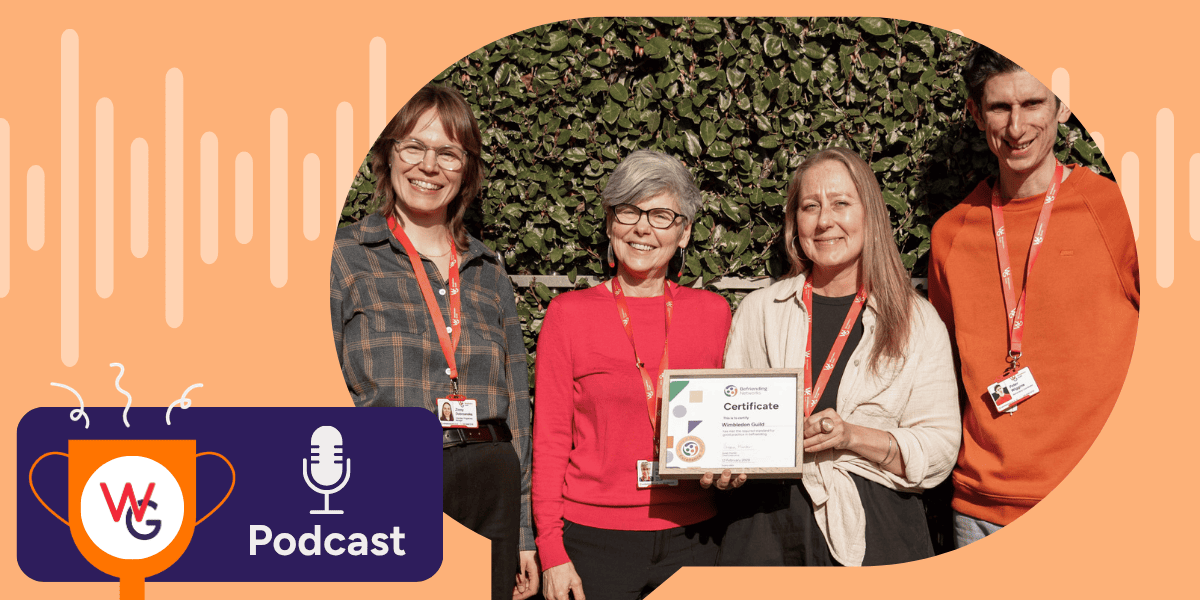
They achieved their Excellence award in February 2026. This was the first time that Wimbledon Guild had undertaken the Quality in Befriending Award and the standard of the evidence submitted was incredibly high.
Ania shares how she and her team prepared for assessment, taking advantage of our resources, training and 1:1 support, as well all what their service has gained from being Excellence Award holders.
Hayley
So, I’m Hayley. I’m an Assessor for Befriending Networks, for the Quality in Befriending Award, which is the only award in the UK that is specifically tailored for befriending services. And Ania, do you want to introduce yourself as well?
Ania
Yes, of course. So my name is Anya Dudziec and I’m Befriending Manager at Wimbledon Guild. And obviously we’re based in Wimbledon, but we work throughout the London Borough of Merton.
Hayley
So I invited you along to speak to me today because I was particularly impressed with just how well prepared you were for the Award and that obviously really paid off. You, Wimbledon Guild, have achieved the standard of Excellence your first go around on the Award. So yeah, so thanks for agreeing to speak to me. So would you be able to tell everyone a little bit about your befriending service? So, sort of who you support, what it looks like, just a little bit about yourselves.
Ania
Of course, so our befriending service has been going on for some time actually. The Wimbledon Guild first started in 1907, so I’ve just done a bit of maths work. So we’ve essentially been, the project has been around for about 119 years. It was one of the first services that Wimbledon Guild offered when we started back then. And it’s still one of our most popular ways that people come to us to get support. So we do hear a lot from both befrienders and service users about what befriending brings to their life, really, which is why I think it’s a project that’s continued. We have had lots of changes, of course, at Wimbledon Guild throughout those 100 plus years, but befriending is one of the constants, really, one of the projects that we have delivered for that time. We provide mainly face-to-face volunteer befriending service. It’s mainly for older isolated adults. So one of our projects is for people aged 65 plus, but we also have another project for people aged 50 plus. So we, yeah, generally speaking, we welcome referrals from Merton residents who are housebound, and or living alone and who have been diagnosed with a long term health condition.
Hayley
Thank you. Thanks for explaining a bit about what you do. So when did you first think about doing the Quality Award? Was it quite a short process between thinking about it and doing it, or did you have a bit of a lead-in period?
Ania
Well, I have to say we did actually have quite a long period before we actually decided on embarking on the Award. We’ve been members of the Befriending Network for some time and we’ve been looking at resources available from Befriending Networks, but also exploring the idea of doing the Award. We actually initially had a look, I think possibly about two or three years ago, but it never really seemed the right time to be honest. There was always just a lot going on and obviously we run a busy project and we knew that we would have to allocate resources to completing the Award. So that was the one thing, that was the main reason really why we didn’t fully start for a couple of years. But I think it’s kind of one of those things where there never is the right time in a way. Obviously we had one member of staff, myself, who was coordinating the evidence and also, we were aware of the fact that we’d have to incorporate the Award into regular work. So that’s one reason why we didn’t start straight away.
Hayley
So how did you prepare before you did apply to do it in the end?
Ania
Well, I think the preparation stage really was the main stage. So we did quite a lot of preparatory work before starting the process. I think we’ve, for many years, we know we provide a good service because we’ve always had really good feedback from both service users and volunteers. So I think we sort of already knew that, but it was, we thought it would be useful to get an outside assessor to come in and see and work towards refining our services and really making things as best as we can. So the preparation was, as I mentioned, was the most arduous side of the Award. And we spent probably about a year preparing before we applied to start. We spent about a year working closely across all departments in the organisation. So that was the befriending team, the volunteer team, also a senior management team. So really, it very much involved lots of different departments within the organisation. As mentioned, one member of staff coordinated providing the evidence for the award, but there was lots of preparation across all teams and departments. We had lots of meetings looking at our processes, discussing what we could improve and refining processes and also the template that you provided for us was a great way for us to audit what we’re doing. and really put a cross or tick over what we felt was, matched up to the Award standards.
Hayley
So were you looking over the sort of 60 indicators that we used beforehand then and –
Ania
Yes.
Hayley
And sort of ticking off against each one to see.
Ania
Yeah, that’s right. Yes. Yeah, exactly. So that’s it. was looking at those indicators and really seeing whether we felt that we would achieve that indicator or whether there was a little bit more work to do. We used, we also looked at other resources available. So a lot of them on the Befriending Networks resources, things like fact sheets, and also sessions and courses as well. So I can give one example. We did identify a little gap in our information about boundaries. So what we did, a staff member attended your Boundaries session, the Boundaries course, and we really had a close look at what we’re doing in relation to boundaries. And that resulted in us working on our boundaries agreements. So first of all, working on it, developing a boundaries agreement and then of course implementing that daily within our visits to, basically during our initial home visit with both service user and volunteer. We also attended the Volunteer Management course as well, although we have done sessions in the past, myself and my colleague within our befriending team. We just felt it was a good idea really for a refresher, really, just to see that we’re up to date with things. So we sort of sourced resources really which we felt would be useful for the process.
Hayley
Sounds like lots of lots of preparation was going on. And how did you find the actual assessment process? Was there particular challenges? What was particularly helpful? Just how was it in general?
Ania
I have to say initially it was a little bit daunting and I think because seeing the whole list, there’s a lot of evidence to upload. So we really had to, I had to timetable in days of the week where I was free. So really I developed a quite methodical approach to going through each indicator. We also – although you offered us, you shared your tracker throughout the whole process where you kept your records and we also had the Moodle portal which we used. – on addition to that, we created a spreadsheet as well, an internal spreadsheet really just to keep track of what we’d submitted and how things were going. And also to add the assessor, so yourself, you were a great help along the way and I really appreciated being able to check in with you regularly if there are any questions and things like that. So that was great.
Hayley
Okay, I’m glad I was able to be helpful. And last question, and I know it’s maybe a bit soon to be able to say anything about this too fully, but what do you feel the service has gained from the process?
Ania
It is early, yes. However, I think that the whole process in itself has been incredibly useful in helping us audit what we do. So really we did a full audit of all our policies and procedures. So really just checking that we were providing the best possible service really. And also the other thing, we feel that, as I mentioned before, we do get good feedback from both our service users and volunteers, but it was great to get recognition for our work. I think that was really important for us. So that was a big part of it. And now it was also useful to be able to evidence that we’re up to date with regards to basic requirements of running a project. So I suppose the basic requirements and also delivering the best quality of service as well. And in fact, it’s I have to say it still is a work in progress actually, because although we’ve we achieved the different indicators you specified, we’re still recognising ways that we can improve. So we’re continuing monitoring how we do things and updating things in order to run the service more efficiently and which ultimately results in providing a better experience for our clients and volunteers.
Hayley
Lovely. Well, thank you so much for taking the time to speak to me today. And yeah, and congratulations again, you guys just did fantastically in your assessment.
Ania
Thank you.
Hayley
Yeah, so thanks. Thank you so much.